

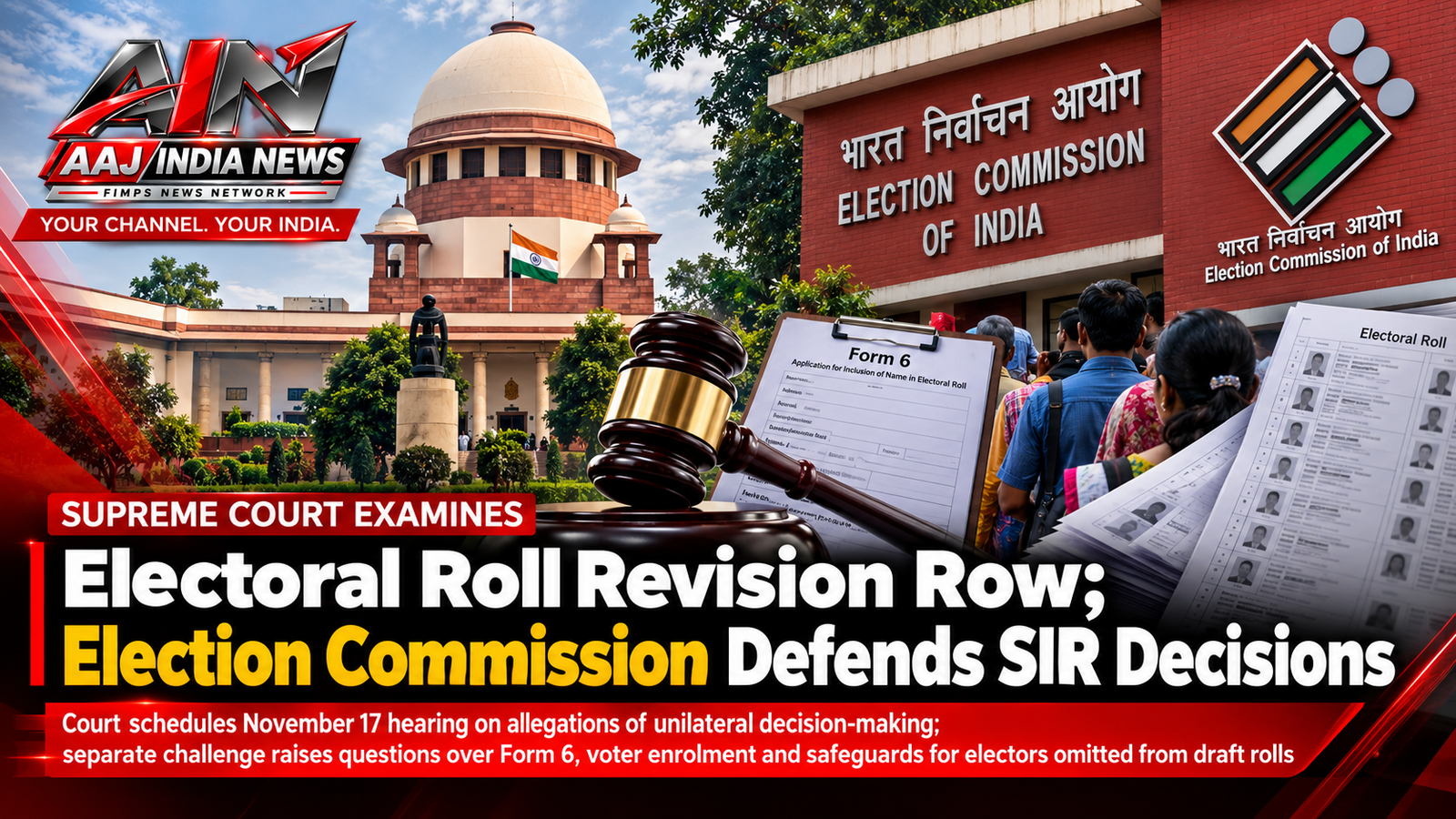
Court schedules November 17 hearing on allegations of unilateral decision-making; separate challenge raises questions over Form 6, voter enrolment and safeguards for electors omitted from draft rolls.
NEW DELHI: The Supreme Court’s scrutiny of the Election Commission of India’s (ECI) functioning has intensified amid legal challenges concerning the Special Intensive Revision (SIR) of electoral rolls, the use of Form 6 for voter enrolment and allegations that key decisions were taken without the concurrence of all election commissioners.
In proceedings reported on October 27 and 28, the court said it would examine issues raised in petitions challenging the poll panel’s decision-making process. The Election Commission has rejected allegations that the Chief Election Commissioner acted unilaterally, maintaining that decisions governing the SIR exercise were approved unanimously.
The proceedings also include a separate challenge concerning Form 6, the application used by eligible citizens seeking inclusion in electoral rolls. The dispute centres on whether additional declarations required during the revision process could complicate enrolment for new voters or restoration of names omitted from draft electoral rolls.
Supreme Court Schedules November 17 Hearing
A three-judge bench headed by Chief Justice of India Surya Kant, along with Justices Joymalya Bagchi and V. Mohana, deferred the hearing on petitions challenging the Election Commission’s functioning to November 17.
The court allowed petitioners time to respond to a counter-affidavit filed by the Election Commission. The commission maintained that decisions relating to the SIR were taken unanimously by Chief Election Commissioner Gyanesh Kumar and Election Commissioners Sukhbir Singh Sandhu and Vivek Joshi.
Petitioners sought directions requiring the commission to preserve internal files, file notings and communications concerning the decision-making process. The court did not issue the requested preservation direction at that stage but indicated that it would examine the issues raised.
Election Commission Rejects Allegations of Unilateral Decisions
In its counter-affidavit, the Election Commission denied that the Chief Election Commissioner independently took decisions concerning the SIR without the concurrence of the other commissioners.
The commission said its orders dated June 24, 2025, October 27, 2025, and May 14, 2026, were approved unanimously. It argued that the exercise was undertaken under its constitutional mandate and in accordance with applicable electoral laws.
The affidavit also disputed the contention that the petitions justified suspending the SIR or restricting the Chief Election Commissioner from functioning. The petitioners, however, have sought judicial examination of the decision-making process and the records relating to the commission’s actions.
These are competing positions placed before the court. The allegations have not been finally adjudicated, and the commission’s response remains part of the ongoing proceedings.
Form 6 Dispute Raises Questions Over Voter Enrolment
A separate petition filed by Trinamool Congress Rajya Sabha MP Dola Sen has brought the use of Form 6 into focus.
Form 6 is used by eligible citizens applying for inclusion in electoral rolls. The dispute concerns an additional declaration introduced during the SIR process and the way it was displayed through the Election Commission’s online application system.
The petition challenges aspects of the commission’s functioning, including alleged changes affecting the form and a press communication that reportedly suggested the Supreme Court had authorised those changes.
The Supreme Court issued notice seeking the Election Commission’s response to the fresh petition. The commission has denied amending the statutory Form 6, maintaining that the additional declaration is a separate document prescribed for the revision exercise rather than an amendment to the form itself.
The commission has said the declaration is intended to help applicants establish a link with earlier electoral rolls through their own details or those of relatives. Where such a link cannot be established, applicants may be required to provide supporting documents under the applicable procedure.
Delhi SIR: Concerns Over Deleted Voters and Restoration
The dispute also has implications for Delhi, where the revision of electoral rolls has prompted separate petitions concerning deleted names, notice procedures and restoration of previously registered voters.
Petitioners have questioned whether electors whose names were omitted from draft rolls should be required to apply through Form 6, which is ordinarily used by people seeking enrolment as voters. They argue that a separate mechanism may be necessary for people who were previously registered but whose names were removed during the revision.
Another issue concerns the disclosure of notices issued to voters and the reasons for identifying their records as having “logical discrepancies”. Petitioners have sought greater transparency about the criteria used to identify such cases.
According to a report published by India Today on October 14, the Supreme Court had scheduled a hearing for October 28 on a plea seeking disclosure of the names of voters who received notices and the reasons for issuing them.
The Election Commission has maintained that names cannot be added to or deleted from electoral rolls except through orders of the competent Electoral Registration Officer under the applicable rules.
Claims and Objections Deadline Approaches
India Today reported that the deadline for claims and objections had been extended to October 30, while publication of the final electoral roll was scheduled for December 4.
Voters who receive notices or discover discrepancies in their electoral details should consult the relevant electoral registration authorities and follow the prescribed procedure within the applicable deadlines. The legal proceedings do not, by themselves, establish that any individual voter has been wrongly excluded.
What the Case Means for Electoral Transparency
The proceedings raise broader questions about the transparency of electoral administration, the documentation required for voter enrolment and the institutional procedures governing decisions by the Election Commission.
For petitioners, access to records and clarity over the decision-making process are central to examining their allegations. For the commission, the issue involves defending the legality of the revision exercise and explaining the distinction between the statutory voter-enrolment form and the additional declaration used during SIR.
The court has not delivered a final ruling on the central allegations. Its next steps will depend on the written responses, supporting records and submissions presented by the parties.
What Happens Next?
The next hearing in the broader challenge to the Election Commission’s decision-making process is scheduled for November 17, giving petitioners time to respond to the commission’s affidavit.
The separate Form 6 proceedings will require the Election Commission to respond to the issues raised in Dola Sen’s petition. The Delhi-specific dispute also places attention on the handling of claims, objections and applications by voters seeking inclusion or restoration.
As the proceedings continue, the key questions will be whether the commission’s procedures comply with applicable law, how the additional declaration should operate and what safeguards should apply to eligible voters whose names are disputed.
AAJ INDIA NEWS will continue to follow the Supreme Court proceedings, the Election Commission’s responses and official updates concerning electoral-roll revision.
Sources: Supreme Court proceedings as reported by The Indian Express, Hindustan Times, The Telegraph and India Today, October 14–28, 2026.
AAJ INDIA NEWS
YOUR CHANNEL. YOUR INDIA.