

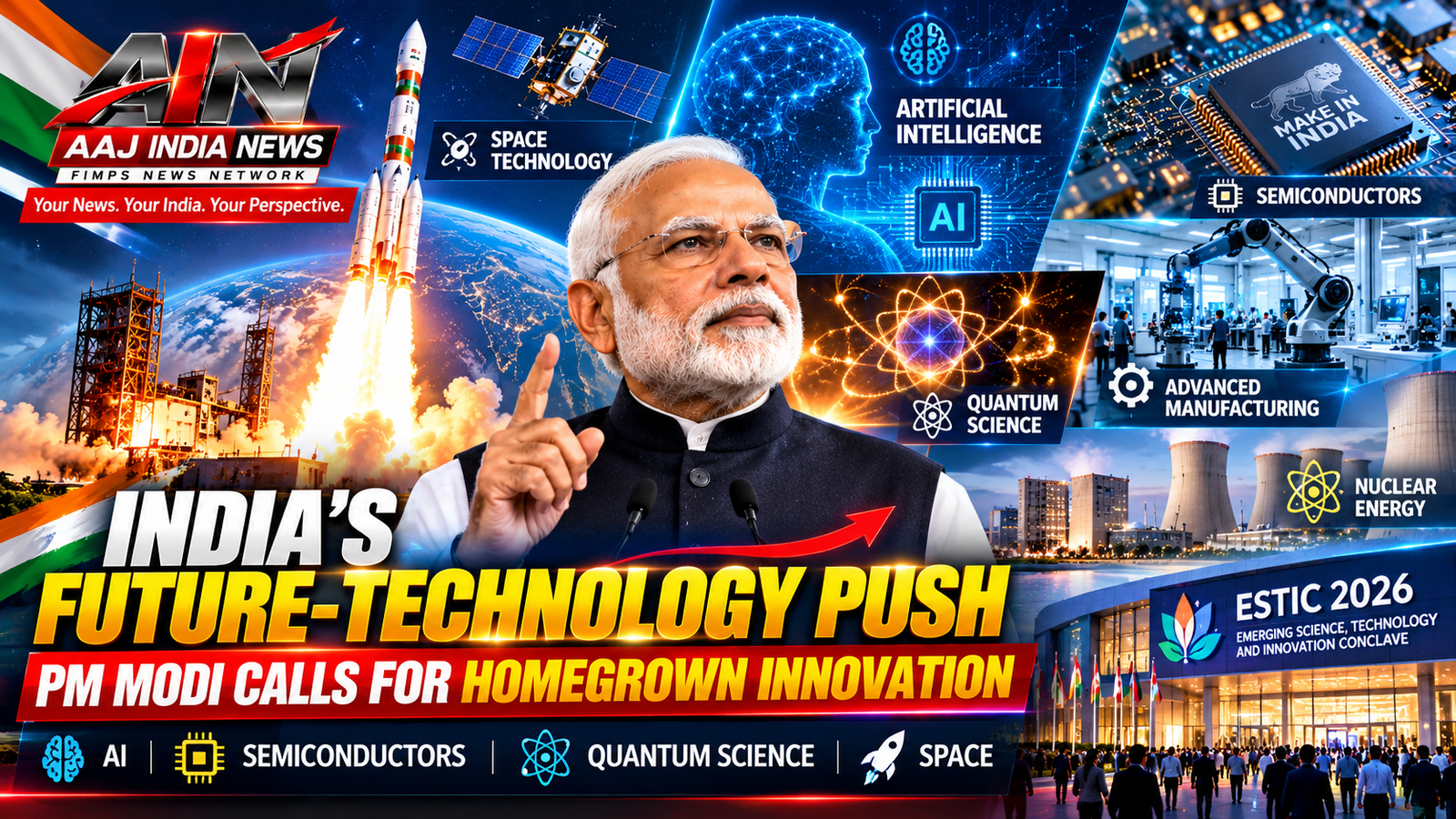
At ESTIC 2026, Prime Minister Narendra Modi outlines a three-year delivery horizon for researchers and startups, highlights progress in nuclear energy and semiconductor manufacturing, and stresses that artificial intelligence must strengthen—not replace—independent scientific thinking.
NEW DELHI: Prime Minister Narendra Modi has called on India’s scientific community, technology companies, startups and young researchers to move beyond adopting technologies developed elsewhere and focus on creating original, globally competitive solutions. Addressing the Emerging Science, Technology and Innovation Conclave (ESTIC) 2026 at Bharat Mandapam on October 27, he placed domestic research, critical-technology capabilities and practical applications at the centre of India’s long-term development ambitions.
The Prime Minister’s message was clear: scientific progress must produce measurable outcomes. Researchers and innovators were encouraged to establish concrete three-year targets identifying the technologies, prototypes, pilot projects or products they intend to develop. The objective is to connect laboratory research with industrial deployment and public benefit under the broader vision of Viksit Bharat 2047.
The Ministry of Science and Technology reported on October 28 that the conclave’s opening day brought together more than 5,000 delegates, including scientific leaders, policymakers and deep-technology startups. Its programme covered artificial intelligence, advanced manufacturing, biotechnology, quantum communication and other areas considered important to India’s future technological capabilities.
From Technology Adoption to Technology Creation
India’s technology strategy is increasingly focused on developing domestic capabilities in fields that influence economic competitiveness, infrastructure, industrial production and national security.
In his address, Modi contrasted the earlier approach of adopting or adapting technologies developed abroad with the ambition to create original innovations and contribute to global technological development. He cited India’s achievements in space exploration, indigenous vaccine development, digital public infrastructure and emerging manufacturing capabilities as examples of the country’s expanding scientific and engineering base.
The government’s challenge now is to translate this foundation into products and systems that can be developed, manufactured and deployed at scale. That requires more than research papers or laboratory demonstrations: it requires reliable prototypes, investment, skilled personnel, industrial partners and pathways to commercial adoption.
The Prime Minister also stressed that scientific progress should be measured by its contribution to society. Technology must help address practical problems in healthcare, agriculture, education, employment, energy security and disaster resilience.
Artificial Intelligence: Innovation with Independent Judgement
Artificial intelligence was among the central themes of the Prime Minister’s address. India is pursuing homegrown AI capabilities while also expanding the infrastructure, research ecosystem and skills required to use the technology across sectors.
Modi cautioned that AI-generated answers must be verified. Although AI can accelerate routine tasks and improve productivity, he said it should support independent thinking rather than weaken the capacity to question, experiment and assess evidence.
The distinction has particular relevance for scientific research. AI tools can assist with data analysis, modelling, literature review and the identification of patterns, but researchers remain responsible for validating results, evaluating assumptions and determining whether a conclusion is scientifically sound.
At ESTIC, discussions on generative and autonomous AI included homegrown large language models, access to high-performance computing under the IndiaAI initiative, agentic AI and frameworks for safer deployment. These areas point to a wider policy question: how can India develop useful AI systems while addressing reliability, cybersecurity, accountability and responsible use?
For businesses and public institutions, the practical test will be whether AI applications deliver dependable improvements in productivity and service delivery—not simply whether they incorporate new technology.
Semiconductors and Advanced Manufacturing
Semiconductors are another strategic priority. Chips are essential to smartphones, computers, telecommunications equipment, vehicles, industrial automation, defence systems and a growing range of AI applications.
India’s efforts to expand semiconductor manufacturing are intended to strengthen domestic supply chains and reduce exposure to external disruptions. In his ESTIC address, Modi referred to India-made semiconductor chips beginning to be shipped internationally, presenting the development as part of the country’s broader push into critical technologies.
Building a durable semiconductor ecosystem requires a coordinated set of capabilities: fabrication facilities, specialised materials and equipment, packaging and testing, engineering talent, dependable utilities and a network of component suppliers. Commercial competitiveness also depends on manufacturing yields, scale, cost and sustained demand.
The conclave’s advanced-manufacturing discussions addressed technologies such as digital twins, collaborative robotics, additive manufacturing and precision metrology. These tools can help manufacturers improve product quality, optimise production processes and strengthen supply chains, including those serving micro, small and medium enterprises.
The larger objective is to connect research institutions with industrial users so that innovations can move from prototypes into production.
Quantum Technology, Biotechnology and Next-Generation Communications
The government is also identifying quantum technologies, biotechnology, advanced materials, robotics, clean energy and next-generation communications as priority areas for long-term investment.
Quantum communication and quantum security could become increasingly relevant to the protection of sensitive information and critical digital infrastructure. Translating research into operational systems will require further engineering, testing, standards development and careful assessment of practical performance.
Biotechnology offers a different set of opportunities, ranging from diagnostics and precision medicine to agricultural innovation and industrial processes. ESTIC sessions explored systems and synthetic biology, including engineered biological systems and approaches that could support healthcare, sustainable agriculture and waste-to-value manufacturing.
These fields also require effective oversight. As the technologies become more capable, questions of safety, security, ethics and regulation will need to be addressed alongside innovation.
By identifying multiple priority domains, the government is signalling that India’s future-technology ambitions are not confined to a single industry. The intended approach is to build capabilities across interconnected sectors, supported by research institutions, industry, startups and public policy.
Nuclear Energy and Space: Strategic Capabilities Expand
Energy security and space technology featured prominently in the Prime Minister’s review of India’s recent technological developments.
On nuclear energy, Modi highlighted progress in the indigenous 500-megawatt Prototype Fast Breeder Reactor, which had achieved first criticality earlier in 2026. Fast breeder technology is part of India’s long-term nuclear programme and is intended to help use nuclear fuel resources more effectively. Its broader contribution will depend on further technical progress, operational performance, safety and the successful development of the supporting fuel cycle.
In the space sector, the Prime Minister pointed to satellite-docking capability and the growing role of Indian startups. He also referred to a domestic space startup placing a satellite into orbit using an Indian-made rocket.
The expanding participation of private companies is significant because it can widen the base of engineering expertise and create new commercial applications for satellite communications, Earth observation and other space-based services. Sustained progress will depend on reliable launch capabilities, investment, access to infrastructure and demand for commercially viable space products.
These developments form part of a broader effort to strengthen technologies with implications for communications, industrial capability, scientific research and national resilience.
Research Funding and the Challenge of Commercialisation
A central issue for India’s technology ambitions is how to finance research and move discoveries towards practical deployment.
According to the Prime Minister’s Office account of the address, Modi referred to a ₹1 lakh crore commitment for research, development and innovation announced at the previous edition of the conclave. He said that, over the past year, ₹12,000 crore committed by the government for market-ready laboratory technologies had been matched by an equal amount from private investors, amounting to a combined ₹24,000 crore commitment.
He also cited an increase in annual patent filings from fewer than 50,000 a decade ago to nearly 1.5 lakh in the previous year. Patent filings are one indicator of research and innovation activity, although they do not by themselves establish whether an invention is commercially successful or produces measurable economic and social benefits.
The Anusandhan National Research Foundation and related research-and-innovation mechanisms are intended to strengthen the connection between scientific research and development. The key implementation question is whether funding can support the full journey from early-stage research to validated technology, manufacturing, market adoption and long-term maintenance.
This transition is particularly important for deep-tech startups, which often face long development cycles, high research costs and uncertainty before products generate revenue.
Startups and the Next Generation of Researchers
The conclave also highlighted the role of startups and young researchers in expanding India’s technological base.
The Ministry of Science and Technology said the event featured research displays, startup prototypes and poster presentations intended to connect innovators with investors, academic institutions, industry and policymakers. Discussions covered AI, biotechnology, advanced manufacturing and other areas where research may lead to new products or industrial processes.
Minister of State for Science and Technology Jitendra Singh described India’s startup ecosystem as having expanded from approximately 400 startups in 2014 to more than 2.3 lakh. He also said that an estimated 50–60 per cent of startups were based in Tier-2 and Tier-3 cities, highlighting the geographic spread of entrepreneurship. These figures are government-reported estimates.
The wider policy challenge is to ensure that the availability of funding and institutional support is matched by access to laboratories, experienced mentors, skilled employees, intellectual-property expertise and customers willing to test and adopt new products.
For students and early-career scientists, technological leadership will depend not only on formal education but also on opportunities to conduct experiments, develop prototypes, learn from failure and work across disciplines.
Technology Must Serve Society
Modi repeatedly connected technological progress with its potential to improve everyday life. He cited domestic work on wearable electroencephalography technology, brain imaging, communications systems, specialised nutritional products and industrial-waste utilisation.
He also referred to a brain-imaging platform at IIT Madras designed to produce high-resolution three-dimensional images of the human brain and support research into complex neurological conditions.
Such examples illustrate the potential value of linking scientific research with clearly defined public needs. In healthcare, technology must be clinically validated and accessible. In agriculture, it must be suited to local conditions. In education, it must improve learning without widening the digital divide. In disaster management, it must deliver timely and reliable information to the people who need it.
The success of emerging technology therefore cannot be measured only by investment totals, patents or the number of startups. Its impact will also depend on affordability, accessibility, safety and the quality of the outcomes it produces.
Cybersecurity and Responsible Innovation
The Prime Minister also warned that emerging technologies bring new risks. AI, synthetic biology and autonomous systems require safety and security to be considered as part of their development, rather than as issues to address after deployment.
AI-enabled cyberattacks and vulnerabilities in financial networks or other critical systems could create risks beyond individual companies. Quantum technologies may eventually affect some existing cryptographic approaches, making research into future-ready security important. The timeline and scale of such risks vary by technology and application, and security strategies must be based on technical evidence rather than speculation.
India’s future-technology agenda will therefore need to combine innovation with testing, security standards, responsible deployment and clear accountability.
A Three-Year Test for India’s Technology Ambitions
The Prime Minister’s call for concrete three-year targets gives the conclave a practical benchmark: researchers, startups, industry leaders and students should identify what they intend to build and how progress will be measured.
That approach shifts the emphasis from broad ambitions to deliverables—whether a validated prototype, a tested industrial process, a new product, a research breakthrough or a scalable public-service application.
For India, the next phase of technological development will depend on several connected factors: sustained research funding, stronger links between universities and industry, a skilled workforce, dependable manufacturing and digital infrastructure, and the ability to translate discoveries into useful products.
The government has identified AI, semiconductors, quantum science, biotechnology, nuclear energy, space, advanced manufacturing and clean energy as important areas of focus. The task ahead is to demonstrate that investments in these fields can produce reliable capabilities, competitive businesses and measurable public benefits.
ESTIC 2026 has placed that challenge at the centre of the national discussion. Whether the ambitions translate into lasting technological leadership will depend on what India’s research institutions, companies and public agencies deliver in the years ahead.
- Press Information Bureau — Prime Minister’s address at ESTIC 2026, 27 October 2026.
- Press Information Bureau — ESTIC 2026 opening-day proceedings, 28 October 2026.
- Prime Minister of India’s official website — ESTIC 2026 address.
Editorial note: Funding, patent and startup figures are attributed to government statements and should not be interpreted as independent assessments of commercial performance or technological self-sufficiency.
AAJ INDIA NEWS will continue to follow India’s developments in science, technology, AI, semiconductors and strategic innovation.
AAJ INDIA NEWS
Your News. Your India. Your Perspective.
WATCH THE FULL VIDEO
Watch the full video for the complete address and discussion.