

adminEdit Profile
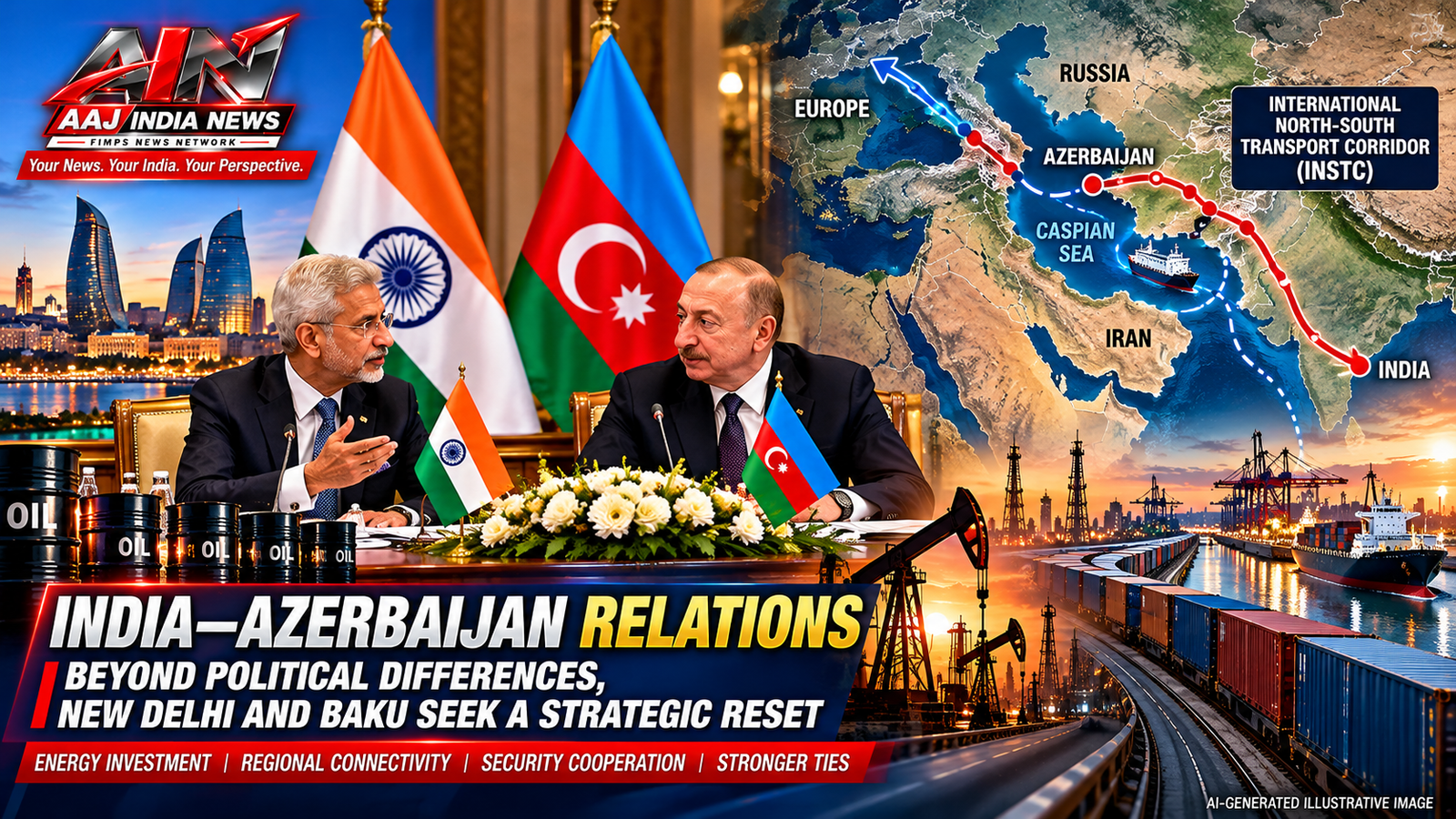
India–Azerbaijan Relations: Beyond Political Differences, New Delhi and Baku Seek a Strategic Reset
After tensions over Azerbaijan’s position during Operation Sindoor, External Affairs Minister S. Jaishankar’s visit to Baku signals an effort to rebuild trust through energy investment, regional connectivity, security cooperation and renewed diplomatic engagement.
NEW DELHI: India and Azerbaijan are attempting to recalibrate a bilateral relationship that has experienced significant political strain, with recent diplomatic engagements indicating a renewed focus on economic cooperation, energy security and regional connectivity. External Affairs Minister S. Jaishankar’s visit to Baku on October 23 represents an important step towards repairing ties that deteriorated after Azerbaijan’s alignment with Pakistan during Operation Sindoor in 2025.
The emerging diplomatic reset is not simply an effort to return to business as usual. It reflects a more complicated strategic calculation in which both countries have economic interests to protect, regional partnerships to manage and differences to address.
For India, Azerbaijan occupies a relevant position in the energy-rich Caspian region and along routes connecting South Asia with Russia, the Caucasus and Europe. For Azerbaijan, India represents a major economy, an important energy investor and a potential partner in trade, technology, pharmaceuticals, tourism and transport connectivity.
The question is whether these shared interests can support a more resilient relationship without requiring either country to abandon its independent foreign-policy choices.
A Diplomatic Reset After Operation Sindoor
The deterioration in India–Azerbaijan relations followed the military confrontation between India and Pakistan in May 2025. Azerbaijan’s public alignment with Pakistan during the period surrounding Operation Sindoor generated criticism in India and complicated the political atmosphere between New Delhi and Baku. The relationship was also affected by the broader strategic coordination among Azerbaijan, Pakistan and Türkiye.
The resulting strain highlighted a vulnerability in bilateral ties: economic cooperation and people-to-people connections could not entirely insulate the relationship from geopolitical disagreements.
Foreign Office Consultations held in Baku on April 3, 2026, provided an institutional channel for discussing economic cooperation, energy, tourism, education and differences of opinion. The two sides also discussed regional security and the evacuation of Indian citizens from Iran.
A further signal came on September 1, 2026, when Prime Minister Narendra Modi briefly interacted with Azerbaijani President Ilham Aliyev on the sidelines of the Shanghai Cooperation Organisation summit in Bishkek. Jaishankar’s subsequent visit followed that leadership-level contact.
These engagements suggest that both governments recognise the value of maintaining communication even when their strategic assessments differ.
Jaishankar’s Baku Visit: What Changed?
During his October 23 visit, Jaishankar met President Ilham Aliyev and Foreign Minister Jeyhun Bayramov. The discussions covered bilateral relations, trade, investment, energy, connectivity, regional security and international developments.
Jaishankar described his talks with Bayramov as productive and said the two countries had agreed to explore greater cooperation in energy and other sectors. He also emphasised closer coordination on the International North-South Transport Corridor (INSTC), expanded air connectivity and opportunities for professional exchanges.
The discussions included terrorism, regional instability and developments across West Asia, Europe and Eurasia. Jaishankar reiterated India’s position that disputes should be settled through dialogue and diplomacy. He also welcomed the peace agreement between Azerbaijan and Armenia, expressing hope that it would contribute to durable regional peace.
The visit combined two objectives: restoring momentum in practical bilateral cooperation and maintaining dialogue on matters where the countries may not always share the same perspective.
However, a diplomatic reset should not be confused with a complete resolution of political differences. The immediate evidence points to renewed engagement and an intention to expand cooperation, rather than a formal settlement of every outstanding disagreement.
Energy: The Strongest Economic Foundation
Energy remains one of the most substantial components of the India–Azerbaijan relationship.
According to India’s Ministry of External Affairs, ONGC Videsh Limited (OVL), the overseas investment arm of Oil and Natural Gas Corporation, has invested more than US$1.2 billion in interests associated with Azerbaijan’s Azeri-Chirag-Gunashli (ACG) oil fields and the Baku-Tbilisi-Ceyhan (BTC) pipeline.
In November 2024, OVL completed the acquisition of an additional 0.615% participating interest in the ACG oil field from Equinor for US$60 million. The transaction also included a 0.737% interest in the BTC pipeline. Following the acquisition, OVL’s stake rose to 2.925% in ACG and 3.097% in the pipeline.
These investments provide India with an established commercial presence in Azerbaijan’s energy sector. They also create a practical basis for further cooperation in energy-related investment, technical services and associated infrastructure.
For India, diversified energy relationships are relevant to a broader strategy of managing supply risks and maintaining access to international energy markets. Azerbaijan’s position in the Caspian region adds a distinct geographical dimension to that strategy.
Nevertheless, energy investment does not eliminate geopolitical risk. Commercial returns and operational exposure can be affected by regional instability, international sanctions, infrastructure constraints and changes in global oil markets.
Trade and Investment: Room to Expand Beyond Oil
Bilateral trade has grown substantially over the past two decades, although its absolute scale remains modest relative to the size of the Indian economy.
India’s Embassy in Baku reports that bilateral trade reached approximately US$401 million in 2025. Indian exports accounted for US$226 million, while imports from Azerbaijan amounted to US$175 million, consisting predominantly of crude oil.
The figures illustrate a relationship that has a functioning commercial base but considerable scope for diversification.
Several sectors could support broader commercial engagement:
- Pharmaceuticals and healthcare: Indian manufacturers could explore additional export and distribution opportunities.
- Agriculture and food processing: Trade in agricultural products and food-processing technology could broaden commercial ties.
- Information technology: Indian technology companies could assess demand for software, digital services and business-process solutions.
- Renewable energy: Cooperation could be explored in clean-energy technologies, subject to commercial viability and regulatory conditions.
- Tourism and hospitality: Travel demand creates opportunities for airlines, tour operators, hotels and destination-management businesses.
These are potential areas for expansion, not evidence that large-scale new projects have already been agreed. Turning them into measurable outcomes will require business-to-business engagement, financing, market access and sustained institutional support.
The International North-South Transport Corridor
Connectivity is another important reason for New Delhi and Baku to sustain engagement.
The International North-South Transport Corridor is a multimodal transport network intended to connect India with Iran, the Caspian region, Russia and markets further into Europe. It uses a combination of maritime routes, railways and roads, with Azerbaijan forming part of the wider regional network.
During the October visit, Jaishankar said India and Azerbaijan had agreed to coordinate more closely on the corridor. He highlighted its importance for a globalised economy and for expanding the relationship.
The corridor could provide businesses with additional transport options and help diversify trade routes. Its commercial value, however, depends on customs procedures, border infrastructure, multimodal transfers, tariffs, transit rules, financing and regional security.
For India, stronger coordination with Azerbaijan could help advance its broader connectivity interests across Eurasia. For Azerbaijan, participation in regional transport networks can reinforce its role as a transit economy linking markets across the Caspian region and beyond.
Pakistan and Türkiye: The Geopolitical Complications
India’s relationship with Azerbaijan cannot be analysed in isolation from Baku’s relationships with Pakistan and Türkiye.
Azerbaijan and Pakistan have developed close political and defence ties, while Türkiye remains an important partner for Azerbaijan. These relationships form part of Baku’s own regional and strategic outlook. India, meanwhile, has its own security concerns and established relationships with countries across West Asia, the South Caucasus and Europe.
The challenge is not necessarily to eliminate these competing relationships. Sovereign states routinely maintain partnerships with countries whose interests may conflict with those of other partners. The more immediate question is whether disagreements in one relationship should constrain cooperation across every other area.
For India, Azerbaijan’s position during Operation Sindoor remains an important part of the political context. For Baku, relations with Pakistan and Türkiye are established components of its foreign policy.
The diplomatic contacts of 2026 indicate that New Delhi and Baku are willing to resume substantive engagement despite these complications. They do not, however, demonstrate that the underlying strategic differences have disappeared.
India, Armenia and the South Caucasus Balance
The South Caucasus is a strategically sensitive region where India’s relationships with Armenia and Azerbaijan have different historical and political dimensions.
India has developed cooperation with Armenia in areas including defence and regional connectivity, while maintaining commercial and diplomatic relations with Azerbaijan. These relationships require New Delhi to assess developments in the region on their individual merits rather than treating the South Caucasus as a single political bloc.
Jaishankar’s welcome for the Azerbaijan–Armenia peace agreement reflects India’s stated preference for dialogue and diplomatic settlement. A durable peace could reduce regional uncertainty and improve the prospects for transport, trade and investment across the South Caucasus.
For India, stability could also improve the operating environment for connectivity projects and commercial relationships. However, the practical benefits would depend on implementation, the durability of the peace process and the resolution of outstanding regional issues.
Tourism and People-to-People Connections
Tourism is one of the most visible areas of India–Azerbaijan engagement.
India’s Embassy in Baku reports that Azerbaijan received 166,944 Indian tourists in 2025, making India its fourth-largest source of inbound visitors after Russia, Türkiye and Iran. The embassy also records 32,154 visas, including electronic visas, issued to Azerbaijani citizens for tourism or transit visits to India during the same year.
Direct air connectivity between Delhi and Baku and between Mumbai and Baku has supported travel, although services have been affected by regional conflict. According to the embassy’s bilateral brief, IndiGo suspended its seven weekly Delhi–Baku flights from January 26, 2026, while Azerbaijan Airlines continued operating flights between the two countries. Air India also announced a codeshare partnership with Azerbaijan Airlines on August 3, 2026.
Reliable air links matter not only for leisure tourism but also for business travel, student mobility, professional exchanges and family connections.
Security Cooperation and Shared Regional Concerns
Security was another subject discussed during Jaishankar’s visit. The Indian government said the two sides examined terrorism, instability and other common challenges. The Economic Times also reported that security institutions in the two countries maintain working-level cooperation on transnational crime.
Such engagement matters because transnational threats frequently cross national boundaries and require information-sharing, institutional coordination and appropriate legal mechanisms.
At the same time, security cooperation should be assessed through concrete outcomes. Public statements about shared concerns do not, by themselves, establish the existence of new agreements, joint operations or a comprehensive security partnership.
What a Successful Reset Would Require
The renewed engagement between India and Azerbaijan creates an opportunity to rebuild the relationship on a more durable basis. Several steps would help translate diplomatic momentum into results.
- Regular political dialogue: Continue institutional consultations and ministerial meetings to address differences before they become larger obstacles.
- Diversified economic ties: Expand opportunities in pharmaceuticals, technology, agriculture, tourism and services alongside energy.
- Practical connectivity cooperation: Focus INSTC coordination on transit procedures, infrastructure, reliability and measurable commercial benefits.
- People-to-people links: Support students, tourists, professionals and businesses through predictable travel and exchange arrangements.
- Realistic expectations: Recognise differences clearly while protecting areas of mutual interest from avoidable disruption.
These steps would not remove the strategic constraints surrounding the relationship. They could, however, make the partnership more predictable and less vulnerable to individual political disputes.
Conclusion: Pragmatism Over Estrangement
India–Azerbaijan relations are entering a phase of renewed engagement after a period of political strain. Jaishankar’s visit to Baku, the earlier Modi–Aliyev interaction and the focus on energy, trade, connectivity and security all indicate a willingness to rebuild working relations.
For India, Azerbaijan offers energy investments, access to an important Eurasian region and opportunities for wider commercial engagement. For Azerbaijan, India represents a major market and a potential partner in investment, technology, transport and services.
Neither side needs to ignore its strategic differences to pursue these interests. The more important question is whether diplomacy can provide a framework in which disagreements are managed without undermining areas of practical cooperation.
The next phase should therefore be judged by outcomes rather than declarations: increased trade, viable investment, more reliable connectivity, sustained institutional dialogue and measurable progress in areas of mutual interest.
The relationship’s future will depend on whether New Delhi and Baku can convert the current diplomatic opening into a stable and commercially meaningful partnership while maintaining their independent foreign-policy positions.
Sources and Further Reading
- Ministry of External Affairs, India — India–Azerbaijan Relations, April 2026
- The Indian Express — India–Azerbaijan diplomatic reset after Operation Sindoor
- DD India — Jaishankar holds talks with Azerbaijan leadership
- The Economic Times — India and Azerbaijan seek to boost energy investment and connectivity
- Embassy of India, Baku — Bilateral Brief: India–Azerbaijan Relations