

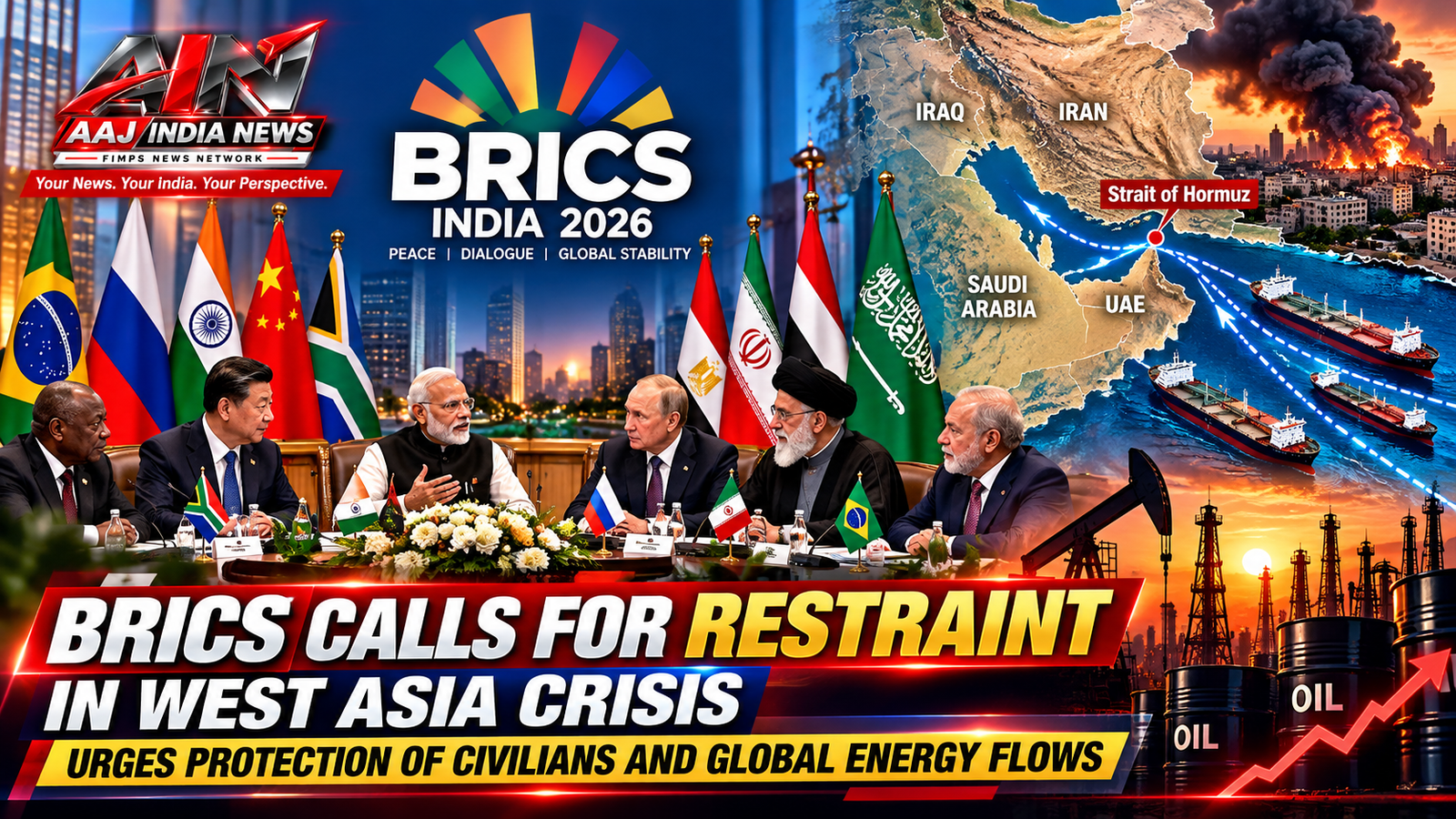
India’s 2026 BRICS chairmanship places diplomacy, respect for sovereignty and uninterrupted trade at the centre of the bloc’s response to escalating tensions in West Asia. Differences among member states, however, underline the limits of a unified geopolitical position.
NEW DELHI, INDIA: BRICS members have renewed their call for maximum restraint amid escalating tensions in West Asia, urging countries to avoid actions that could widen the conflict, protect civilians and civilian infrastructure, and pursue a lasting settlement through dialogue and diplomacy.
The position was reiterated in the joint declaration adopted at the 12th BRICS Parliamentary Forum in New Delhi on October 26–27, as India continues its 2026 chairmanship of the grouping.
The declaration reflects the bloc’s concern that the crisis has consequences extending well beyond the region. Disruption to maritime routes, energy supplies and international supply chains could affect economies across the Global South, including countries that depend heavily on imported oil and gas.
The statement calls for respect for the sovereignty and territorial integrity of states in accordance with the United Nations Charter. It also urges BRICS members to work together to maintain the smooth flow of global trade, supply chains and energy in accordance with international law.
What the BRICS Declaration Says
The joint declaration sets out several priorities for responding to the West Asia crisis:
- Maximum restraint: Avoid further escalation and actions that could aggravate regional tensions.
- Protection of civilians: Safeguard civilian populations, civilian infrastructure and humanitarian access.
- Respect for sovereignty: Uphold the principles of the UN Charter, including the sovereignty and territorial integrity of states.
- Diplomacy and dialogue: Increase efforts to achieve a long-term understanding that can support regional peace and stability.
- Energy and trade security: Maintain the flow of energy, international trade and supply chains in accordance with international law.
These commitments were stated in the parliamentary forum’s declaration and are consistent with the West Asia language adopted in the September 2026 BRICS New Delhi Leaders Declaration.
The declarations establish a common diplomatic position, but they do not, by themselves, constitute a ceasefire agreement, a binding mechanism to end hostilities or a jointly agreed military response.
India’s Chairmanship Faces a Diplomatic Balancing Act
India’s position as BRICS chair in 2026 places it at the centre of efforts to maintain dialogue among countries whose interests and relationships in West Asia differ.
The grouping includes Iran, which is directly involved in the crisis, as well as China, Russia, India, Brazil, South Africa and other members with differing regional and strategic priorities. Some members have close economic and security relationships with countries on opposing sides of the conflict.
India must therefore balance several concerns: preventing further escalation, protecting its citizens and economic interests, maintaining access to energy supplies, and preserving diplomatic engagement with countries across the region.
The September BRICS summit in New Delhi produced a collective statement calling for restraint and diplomacy. Yet earlier ministerial discussions exposed disagreements over how to characterise the conflict.
Reuters reported on May 15 that BRICS foreign ministers failed to agree on a joint statement following their meeting in New Delhi, prompting India to issue a chair’s statement instead.
That history illustrates a central limitation of the bloc: members can agree on broad principles while disagreeing over the attribution of responsibility, the interpretation of specific military actions and the diplomatic measures required to resolve the crisis.
Why Energy Security Is Central to the Response
The economic consequences of the West Asia crisis are a major concern for BRICS economies.
The region is strategically important to international oil and gas markets, while the Strait of Hormuz is a critical passage for global energy shipments. Any prolonged disruption to maritime traffic can affect oil prices, shipping costs, insurance premiums and the reliability of supply chains.
For India, higher crude prices can increase the import bill, intensify inflationary pressures and raise operating costs for businesses. Other energy-importing economies within BRICS face related risks, although the effects vary according to their domestic production, import dependence and energy mix.
The BRICS declarations consequently connect regional stability with the smooth movement of energy and international commerce. This reflects a shared economic interest even where member governments do not agree on every aspect of the conflict.
The declaration, however, does not announce a new collective mechanism to secure the Strait of Hormuz or guarantee uninterrupted shipments. Its emphasis is on cooperation, international law and maintaining the flow of trade and energy.
Protection of Civilians and International Law
The parliamentary forum’s declaration also condemns violations of international humanitarian law, including deliberate attacks on civilians and civilian infrastructure, obstruction of humanitarian access and the targeting of humanitarian personnel.
It stresses accountability for violations and calls for the protection of civilians in accordance with international law.
These provisions are important because the humanitarian consequences of regional conflict can extend beyond immediate battle zones. Damage to essential infrastructure can disrupt electricity, water supplies, healthcare and transport, while insecurity can impede the delivery of food, medicine and emergency assistance.
The declaration expresses a shared normative position. Determining responsibility for individual incidents, however, requires evidence and assessment under the applicable legal framework; the statement itself does not adjudicate specific allegations.
BRICS Unity Has Limits
The West Asia crisis has become a test of whether BRICS can move from broad diplomatic statements to coordinated action on a major international security issue.
The bloc’s expanded membership gives it a wider range of regional relationships and diplomatic channels. It also increases the challenge of reaching consensus among governments with different security partnerships, economic interests and assessments of the conflict.
The disagreement at the May foreign ministers’ meeting demonstrated these constraints. Subsequent summit-level and parliamentary declarations show that members have nevertheless been able to agree on language supporting restraint, civilian protection, sovereignty, diplomacy and economic stability.
The distinction between agreement on principles and agreement on action is consequential. A common declaration can provide a diplomatic framework, but its practical impact depends on whether member governments use their bilateral relationships, multilateral institutions and diplomatic channels to support de-escalation.
The latest statement does not establish that BRICS members have agreed on a unified mediation initiative, sanctions policy or collective security operation.
What Happens Next?
The immediate test for BRICS is whether its shared language can be translated into sustained diplomatic engagement and practical cooperation.
- Diplomatic engagement: Whether BRICS members intensify contacts with the parties to the conflict and support credible efforts to reduce hostilities.
- Maritime and energy security: Whether regional conditions allow shipping and energy supplies to operate safely and predictably.
- Humanitarian protection: Whether governments and international institutions can improve civilian protection, humanitarian access and accountability for violations of international law.
India’s chairmanship provides a platform for continued consultations, but the outcome will depend on the willingness of individual members and the parties to the conflict to take concrete steps.
A Common Call for Restraint, but No Unified Crisis-Resolution Plan
BRICS has articulated a collective position centred on maximum restraint, protection of civilians, respect for sovereignty, diplomacy and the uninterrupted movement of energy and international trade. These principles reflect shared concerns about the regional and global consequences of the West Asia crisis.
At the same time, earlier disagreements among member states show why a common declaration should not be mistaken for a fully coordinated geopolitical strategy. The bloc has established areas of agreement, but its members retain distinct national positions.
For India, the priority is to use its chairmanship to sustain dialogue while safeguarding national interests and supporting efforts to prevent further escalation. For BRICS as a whole, credibility will depend not simply on the language of its declarations, but on whether its members can help turn those principles into tangible diplomatic and humanitarian outcomes.
- Press Information Bureau — Joint Declaration of the 12th BRICS Parliamentary Forum, 27 October 2026
- Embassy of India, Riyadh — BRICS New Delhi Declaration, 13 September 2026
- Reuters — BRICS talks end without joint statement, 15 May 2026
- Al Jazeera — BRICS foreign ministers meeting in India, 14 May 2026
AAJ INDIA NEWS will continue to follow BRICS diplomacy, developments in West Asia and their implications for energy security and global trade.
AAJ INDIA NEWS
Your News. Your India. Your Perspective.