

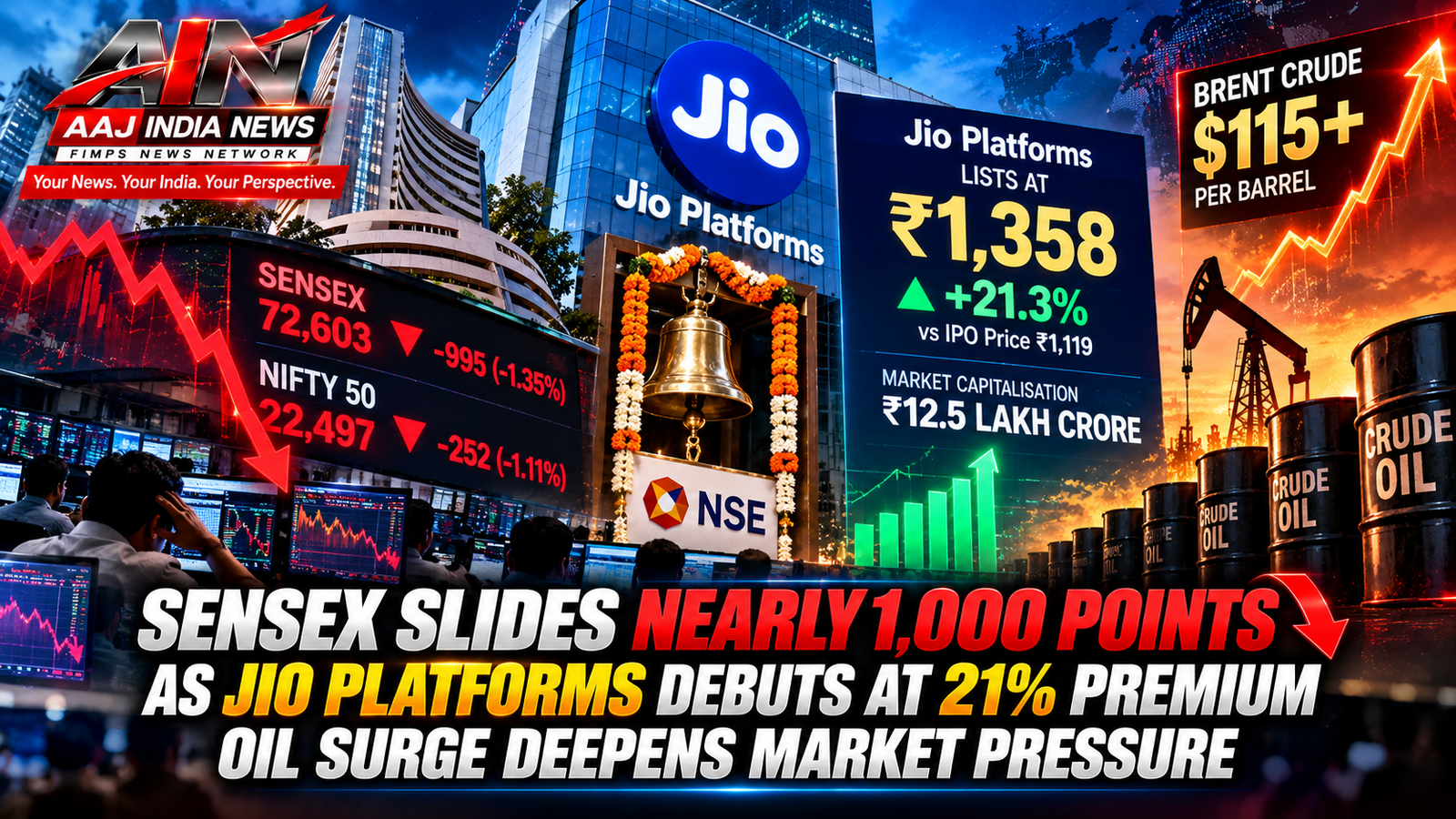
Rising crude prices above $115 a barrel, heavy selling in information technology shares and caution ahead of the US Federal Reserve’s policy decision weigh on Indian equities, even as Jio Platforms commands a market capitalisation of about ₹12.5 lakh crore on listing.
MUMBAI, MAHARASHTRA: Indian equity markets came under significant selling pressure on Wednesday, October 28, as rising crude oil prices, weakness in technology stocks and uncertainty ahead of the US Federal Reserve’s monetary policy decision overshadowed the much-anticipated stock-market debut of Jio Platforms Limited.
The BSE Sensex and NSE Nifty 50 opened lower and extended their declines during the morning session. The Sensex fell as much as 995 points, or 1.35%, to an intraday low of 72,603, while the Nifty 50 dropped 252 points, or 1.11%, to 22,497, according to Business Standard. The pressure reflected a combination of international developments, sector-specific selling and continued concerns about foreign portfolio investment flows.
Against this backdrop, Jio Platforms made its stock-market debut at a substantial premium to its initial public offering price. The listing placed one of India’s largest digital-services businesses directly in the public-market spotlight, even as the broader market struggled to find support.
Jio Platforms Lists at ₹1,358, a Premium of More Than 21%
Jio Platforms listed on the National Stock Exchange at ₹1,358 per share, approximately 21.3% above its IPO issue price of ₹1,119. Its market capitalisation was reported at around ₹12.5 lakh crore, making it one of India’s most valuable listed companies.
The public issue, worth approximately ₹30,213 crore according to The Indian Express, attracted substantial investor interest. The debut provides public-market investors with a direct avenue to participate in the business built around Reliance Industries’ digital services and telecommunications ecosystem.
The listing is also significant for Reliance Industries Limited, Jio Platforms’ parent company. A separate public-market valuation for Jio could help investors assess the value of Reliance’s digital businesses more transparently, although the ultimate effect on the parent company’s valuation will depend on financial performance, ownership structure, capital allocation and market conditions.
The premium at listing indicates strong initial demand relative to the issue price. It does not, by itself, establish the stock’s long-term investment value. Investors will need to examine revenue growth, profitability, capital expenditure, competitive pressures and the company’s ability to sustain returns as a publicly traded entity.
Why the Broader Market Is Under Pressure
1. Crude Oil Climbs Above $115 a Barrel
Rising crude oil prices were one of the most important concerns for Indian markets on Wednesday. Brent crude futures climbed above $115 a barrel after reports of an attack on a Saudi Arabian refinery renewed fears about possible supply disruptions amid tensions in West Asia. Reuters reported Brent at approximately $115.40 a barrel during the morning session.
Higher oil prices can put pressure on India because the country relies heavily on imported crude. A sustained increase can raise fuel and transportation costs, increase input expenses for businesses, complicate inflation management and affect the country’s import bill.
The consequences can extend across sectors. Aviation, logistics, chemicals, paints and other fuel- or petroleum-linked industries may face higher costs, while investors may become more cautious about companies whose profitability is sensitive to energy prices.
Oil and gas producers can experience different effects from those faced by fuel-consuming businesses, depending on their product mix, pricing arrangements, refining margins and regulatory exposure. Consequently, the effect of higher crude prices is not uniform across the market.
2. IT Shares Lead the Decline
Information technology stocks were among the weakest performers in Wednesday’s session. The Nifty IT index fell by more than 3% during the morning, with major companies including Infosys, Tata Consultancy Services, HCLTech, Tech Mahindra and Mphasis recording losses.
Market commentary pointed to concerns about artificial intelligence and its potential implications for the technology-services business model. Investors are assessing how automation, AI-assisted software development and changing client spending patterns could affect traditional outsourcing revenue, staffing requirements and pricing structures.
However, the sector’s performance reflects more than one factor. Global technology sentiment, company-specific earnings expectations, currency movements and valuation levels can all influence share prices. A single session’s decline does not establish the long-term impact of AI on any particular company.
The weakness in large IT companies also contributed to pressure on benchmark indices because of their substantial representation in the Indian equity market.
3. Federal Reserve Decision Adds to Caution
Investors were also watching the US Federal Reserve’s policy meeting, with its decision and accompanying policy statement scheduled for October 28. Monetary policy signals from the United States can influence global bond yields, currency markets, equity valuations and flows into emerging-market assets.
A change in expectations about US interest rates can affect the relative attractiveness of emerging-market investments. For India, the interaction between global rates, the rupee, foreign portfolio flows and domestic earnings expectations remains an important determinant of market sentiment.
The Fed decision was still a pending event in the morning reports cited in the supplied account; its eventual outcome and subsequent market reaction should be assessed separately from the pre-decision decline.
Foreign Investor Flows Remain an Important Concern
Foreign portfolio investor activity has been another source of pressure on Indian equities. Market analysts cited continued foreign selling and the need for a sustained improvement in overseas investor demand as important factors in any potential recovery.
Foreign selling can weigh on large-cap shares and benchmark indices, although its effect depends on the scale and timing of transactions, domestic institutional buying and broader liquidity conditions.
Domestic mutual funds, insurance companies and individual investors can help absorb some of this selling, but their activity does not necessarily prevent short-term volatility. Market direction also depends on corporate earnings, valuations, interest rates and the outlook for economic growth.
Investors should distinguish between daily trading flows and longer-term investment trends. A few sessions of selling or buying do not, on their own, establish a durable change in market direction.
Reliance Industries Faces a Separate Valuation Question
Jio Platforms’ strong debut did not prevent selling pressure in Reliance Industries shares. The parent company’s stock declined by as much as 2% during the session, according to India Infoline, while the market focused on the Jio listing and Reliance’s upcoming quarterly results.
The divergent movements illustrate an important feature of corporate valuations: a subsidiary’s listing performance and its parent company’s share price do not necessarily move in the same direction.
Jio Platforms’ market valuation may provide a more visible benchmark for the value of Reliance’s digital-services business. But Reliance Industries is a diversified conglomerate, and its own valuation also reflects its other businesses, debt, capital expenditure, cash flows and corporate structure.
Investors will also be watching Reliance Industries’ second-quarter results, scheduled for October 30 according to the market report. The results could provide further information about operating performance and business trends.
What Jio’s Listing Means for India’s Capital Markets
Jio Platforms’ entry into the public markets is a significant development for India’s IPO landscape. Its size, brand recognition and digital-services footprint make it an important test of investor appetite for large technology-linked offerings.
A successful debut can demonstrate the depth of demand for a major issue, but the listing premium should not be confused with a guaranteed future return. Share prices can change rapidly as investors reassess growth expectations, valuations and financial disclosures.
For the wider market, the event also highlights the difference between company-specific demand and overall market sentiment. A high-profile IPO can attract considerable attention and trading activity even when benchmark indices are declining because of macroeconomic or global factors.
The key questions over the coming quarters will include whether Jio Platforms can sustain growth, expand monetisation across its digital ecosystem, manage investment requirements and convert its scale into durable profitability.
What Investors Will Watch Next
- Crude oil: Whether prices remain above $115 a barrel or ease as supply concerns develop.
- Federal Reserve: The policy decision and guidance on the future path of US interest rates.
- IT earnings and outlook: Whether technology companies provide greater clarity on AI-related opportunities, costs and business-model changes.
- Foreign investment flows: Whether overseas investors continue selling or return as buyers.
- Jio Platforms: Trading after the initial listing, disclosures and the market’s assessment of its valuation.
- Reliance Industries results: The company’s second-quarter performance and management commentary on its principal businesses.
These factors could affect sectors differently. Oil-sensitive companies, technology exporters, financial stocks and large conglomerates do not share the same earnings drivers, and investors should avoid treating the market as a single uniform asset.
A Strong Debut in a Weak Market
Wednesday’s trading session presented two contrasting developments: Jio Platforms’ strong listing and a broad decline in Indian benchmark indices. The debut reflected demand for a major digital-services business, while the wider market remained sensitive to elevated energy prices, global monetary-policy uncertainty and selling in IT stocks.
The distinction matters. Jio’s listing premium is an initial market outcome, not a guarantee of future performance. Similarly, the Sensex and Nifty’s intraday losses do not by themselves determine the market’s longer-term direction.
For investors, the immediate task is to evaluate company fundamentals alongside the macroeconomic environment. The trajectory of crude oil, the Federal Reserve’s policy signals, corporate earnings and the sustainability of foreign and domestic investment flows will help determine whether the pressure seen on October 28 persists or begins to ease.
Market prices and figures in this report reflect the cited reporting period and may change during subsequent trading sessions.
AAJ INDIA NEWS will continue to track developments in Indian equity markets, Jio Platforms’ post-listing performance, crude oil prices and global monetary-policy signals.
AAJ INDIA NEWS
Your News. Your India. Your Perspective.