

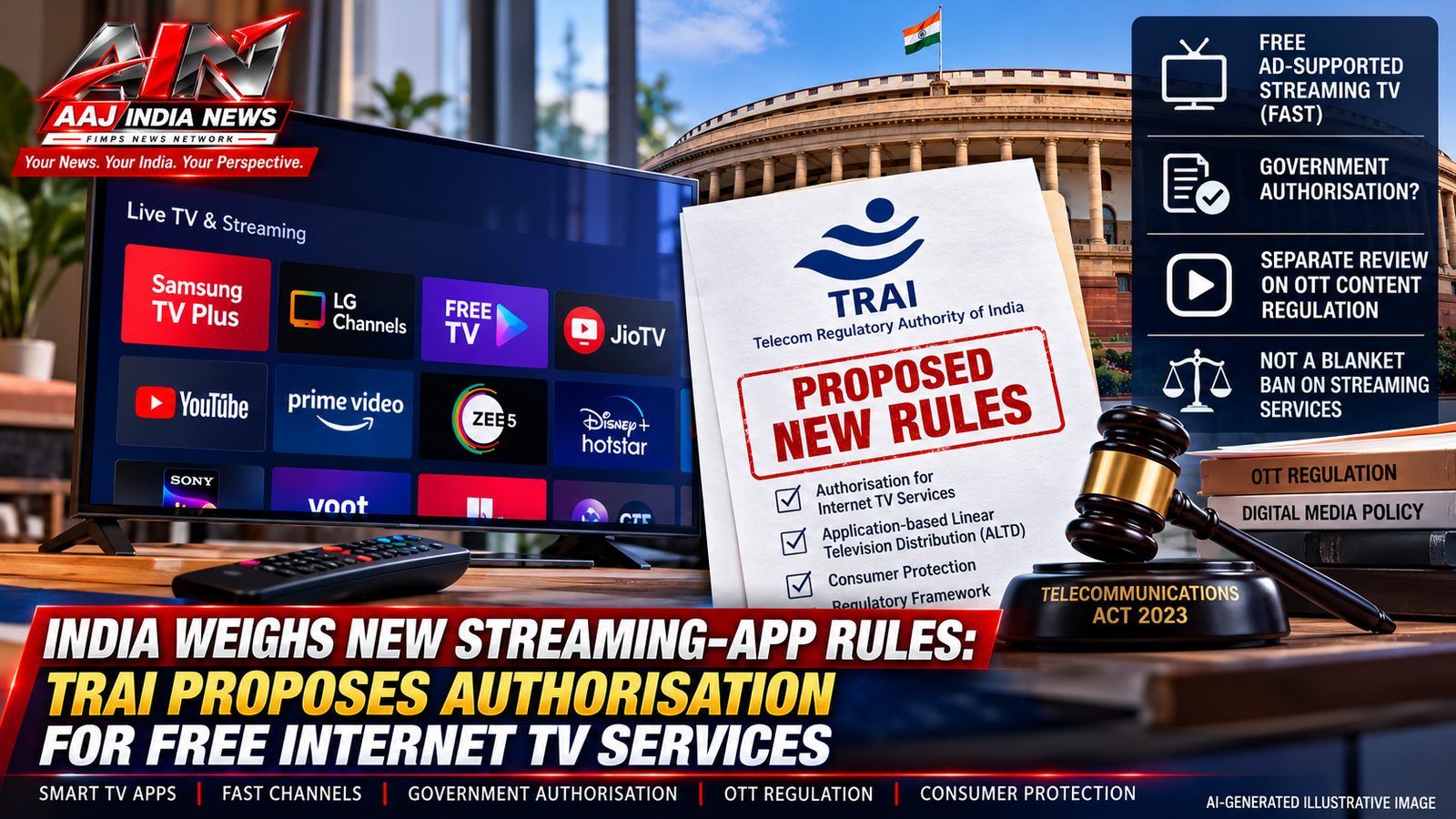
TRAI has recommended government authorisation for certain applications that distribute scheduled television channels over the internet. Separately, the Centre is examining the legal framework for on-demand OTT content. Neither development amounts to a blanket ban on streaming services.
NEW DELHI: India is considering a more structured regulatory framework for internet-based television distribution, with the Telecom Regulatory Authority of India (TRAI) recommending government authorisation for applications that deliver scheduled television channels over the internet.
The recommendations, released on October 26, 2026, propose a category called Application-based Linear Television Distribution (ALTD). These services aggregate scheduled television channels and make them available through internet-connected devices, including smart TVs, mobile applications and web platforms. Many operate through advertising-supported models commonly known as Free Ad-Supported Streaming Television (FAST).
The proposal comes as the government separately examines whether India’s existing legal framework for on-demand streaming content needs amendments or a dedicated law. Although both developments concern digital entertainment, they address different regulatory questions.
TRAI has issued recommendations, not final enforceable rules. The Ministry of Information and Broadcasting must decide what action, if any, to take. The proposals do not establish a blanket ban on free streaming applications.
What Is TRAI Proposing?
TRAI has recommended a light-touch authorisation framework for application-based linear television services. The stated objectives include consumer protection, regulatory certainty, innovation and a more consistent approach to internet-based television distribution.
The main recommendations include:
- Government authorisation: Covered application providers would need authorisation under the Telecommunications Act, 2023.
- Proposed fees: A one-time entry fee of ₹1 lakh and an application-processing fee of ₹10,000.
- Long-term validity: An initial authorisation period of 20 years, renewable for successive periods of 10 years.
- Authorised applications: The Ministry would maintain a repository of authorised applications, with proposed responsibilities for device manufacturers and operating-system providers.
- Consumer complaints: Application providers would serve as the primary contact for grievances concerning their covered services.
- No recurring authorisation fee proposed: TRAI has recommended no recurring authorisation fee, bank guarantee or security deposit.
These are recommendations from the regulator. The fees, validity periods and compliance obligations should not be treated as rules already in force.
Which Streaming Services Could Be Affected?
The proposed ALTD category focuses on services that aggregate and distribute scheduled television channels through internet-based networks. Such services may be accessed through smart-TV applications, mobile apps, websites and other compatible interfaces.
Platforms such as Samsung TV Plus and LG Channels illustrate the type of free, advertising-supported television service relevant to the discussion. Whether a particular service falls within the final framework would depend on the adopted rules and its operating structure.
TRAI’s recommendations distinguish these services from other forms of online video. Broadcaster-owned applications distributing only their own channels or channels belonging to their corporate group are excluded from the proposed scope described by the regulator. Live streams on social-media intermediaries are also excluded.
Consequently, not every application that carries video content would automatically qualify as an ALTD provider. On-demand streaming libraries, video-sharing services, social-media streams and scheduled television aggregators operate through different models and may be subject to different provisions.
What Happens to the Channels Carried by These Apps?
Under the recommendations, ALTD providers would be permitted to distribute television channels that already hold the required government permission or authorisation.
TRAI has also proposed a registration route for internet-native linear television channels—channels created specifically for distribution through these applications. The proposed route would apply to non-news channels, while news and current-affairs channels would remain subject to applicable government permission requirements.
For internet-native non-news channels, TRAI has recommended an annual registration fee of ₹1 lakh per channel.
The approach would give scheduled television distribution an identifiable authorisation framework even when it is delivered through an application rather than conventional cable or direct-to-home infrastructure.
The practical impact will depend on how the government implements the recommendations, including how existing services are treated and whether transition arrangements are provided.
Why Has the Regulator Intervened?
The Ministry of Information and Broadcasting referred the issue to TRAI in December 2025 after concerns were raised about the regulatory treatment of internet-based television distribution.
Traditional cable and direct-to-home operators function under established regulatory and authorisation arrangements. FAST applications, by contrast, can distribute scheduled television channels through internet-connected devices without necessarily following an identical framework.
TRAI’s consultation examined whether this difference created a need for greater regulatory consistency. According to the regulator, it received 207 comments and 11 counter-comments on its consultation paper and held an open-house discussion in June 2026.
The central policy challenge is to maintain fair competition and consumer safeguards without imposing unnecessary costs or restrictions on internet-based services.
Supporters of a formal framework may argue that comparable television services should face clear and predictable obligations. Industry participants, meanwhile, may seek clarity on the effect on existing applications, foreign-owned platforms, app-store distribution and future investment.
Will Viewers Have to Pay for Free Streaming Television?
The recommendations do not propose a blanket ban on free streaming television. Nor do they establish that viewers must begin paying subscription charges to watch free, advertising-supported channels.
However, compliance requirements could affect how some applications are distributed. If the recommendations are implemented as proposed, covered services would need to obtain the relevant authorisation, while manufacturers and operating-system providers would have responsibilities concerning the availability of authorised applications.
For viewers, the eventual effects will depend on which services qualify, how existing applications are treated and whether providers pass additional compliance costs on to users or advertisers.
The proposal to include ALTD viewership in the television audience-measurement framework could also influence advertising decisions. More consistent audience data may help advertisers compare scheduled internet television with other television distribution channels.
These are potential consequences, not confirmed changes to the price or availability of any particular service.
A Separate Debate Over OTT Content Regulation
Alongside TRAI’s recommendations, the government is examining whether the existing legal framework for on-demand OTT content needs to be strengthened.
Reporting published on October 26 indicated that the Ministry of Information and Broadcasting had discussed possible legislative changes with the Ministry of Electronics and Information Technology. Options reportedly under examination include amendments to the Cinematograph Act, 1952, or the Information Technology Act, 2000, or the introduction of a separate statutory framework.
The discussions follow complaints about alleged obscenity and vulgarity on streaming platforms. Officials cited in the reporting said the Information and Broadcasting Ministry had received more than 1,000 representations a month during the preceding six months. This is a reported government tally, not an independent assessment of the legality of the content concerned.
OTT platforms are currently governed principally by Part III of the Information Technology (Intermediary Guidelines and Digital Media Ethics Code) Rules, 2021. The framework includes age-based classifications, content descriptors, parental controls and a three-tier grievance redressal mechanism.
The government is considering whether the existing framework adequately addresses complaints and enforcement issues or whether additional legislation is required. The reports cited here do not establish that a new OTT-content law has been finalised.
Two Separate Regulatory Developments
Focus: Authorisation and distribution of scheduled television channels through applications.
Focus: The legal framework governing on-demand streaming content and related complaints.
What the Proposals Could Mean for Technology Companies
If adopted, the ALTD framework could create new compliance responsibilities across the technology ecosystem.
- Streaming application providers: Assess whether their services fall within the proposed definition, obtain authorisation where required and establish complaint-handling procedures.
- Smart-TV manufacturers and operating-system providers: Potentially verify that covered applications are authorised and available through approved distribution channels.
- Broadcasters and content owners: Ensure that channels distributed through covered services hold the necessary permission or registration.
- Advertisers and measurement companies: Assess the implications of integrating ALTD viewership into television audience-measurement systems.
- Foreign companies: Review the reported recommendation that covered foreign providers operate through an Indian entity, subject to the final framework.
For startups and smaller technology businesses, the proposed low entry fee and absence of a recurring authorisation fee may limit some direct costs. Nevertheless, technical compliance, legal advice, reporting and distribution requirements could create additional operational burdens.
What Happens Next?
The next stage is for the Ministry of Information and Broadcasting to examine TRAI’s recommendations and determine whether to accept them, modify them or pursue a different approach.
If the government proceeds, the resulting rules will need to clarify the authorisation process, implementation timetable, treatment of existing services, channel-registration requirements and responsibilities of device manufacturers and operating-system providers.
The separate review of OTT-content regulation will also require clarity on the legal provisions under consideration, the role of platform self-regulation and the circumstances in which government intervention would be appropriate.
Until these steps are completed, users and businesses should distinguish between a regulator’s recommendation, a government proposal and an enforceable legal requirement.
Conclusion: Regulation Is Advancing, but the Final Framework Remains Undecided
India’s proposed streaming-app regulations mark another attempt to adapt broadcasting policy to the growth of internet-connected televisions and application-based distribution.
TRAI has recommended a formal authorisation system for covered linear television services, including provisions for channel registration, consumer complaints and oversight of app distribution. Separately, the government is examining possible changes to the legal framework for OTT content.
Both developments raise questions about consumer protection, fair competition, freedom of expression, regulatory costs and the future of digital entertainment.
The position reported here is clear: TRAI has issued recommendations and the government is examining OTT-content regulation, but these developments do not establish that all streaming applications will be licensed or that streaming services are being banned. The final effect on companies and viewers will depend on the decisions and rules that follow.
Sources and Further Reading
- Press Information Bureau — TRAI recommendations on application-based linear television distribution, 26 October 2026
- Hindustan Times — Proposed authorisation for free internet TV channels, 27 October 2026
- NDTV — Centre explores a legal framework for OTT content, 26 October 2026
- Outlook India — Government examines possible legal changes to OTT regulation, 26 October 2026
AAJ INDIA NEWS will continue to follow developments in India’s streaming-app policy, TRAI recommendations and the government’s review of OTT-content regulation.
AAJ INDIA NEWS
Your News. Your India. Your Perspective.