

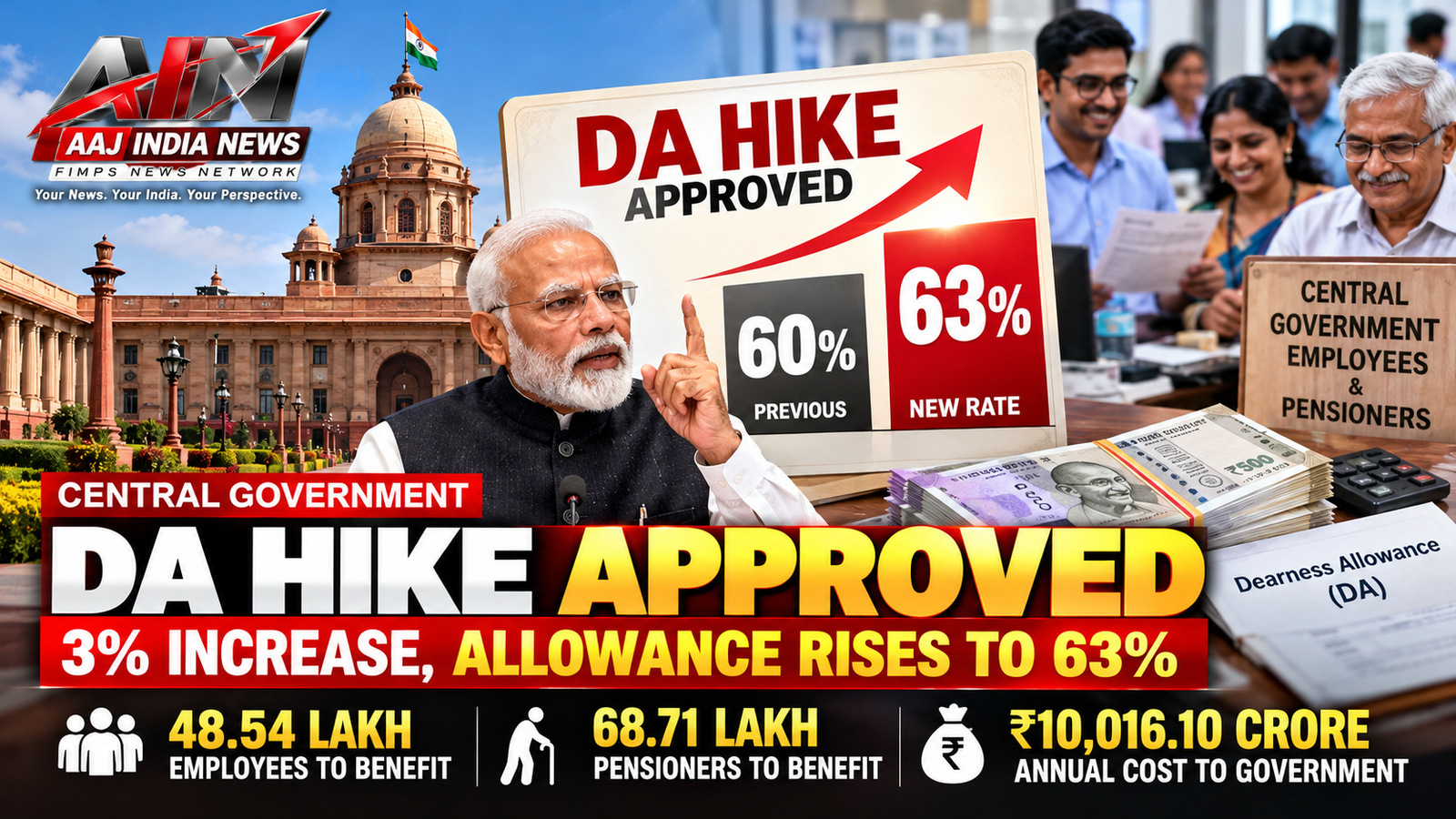
Central Government DA Hike: Cabinet Approves 3% Increase, Allowance Rises to 63%
The decision, effective retrospectively from July 1, 2026, is expected to benefit 48.54 lakh central government employees and 68.71 lakh pensioners, with an estimated annual cost of ₹10,016.10 crore.
NEW DELHI: The Union Cabinet has approved a 3-percentage-point increase in Dearness Allowance (DA) for central government employees and Dearness Relief (DR) for pensioners, raising both rates from 60% to 63% of basic pay and basic pension, respectively. The revised rates will take effect from July 1, 2026, according to the government’s announcement.
The decision is expected to benefit approximately 48.54 lakh serving central government employees and 68.71 lakh pensioners. The combined annual financial implication for the Union government has been estimated at ₹10,016.10 crore.
Because the revised rates apply retrospectively from July 1, eligible beneficiaries may receive arrears for the applicable period, subject to the government’s implementation and payment instructions.
DA Hike 2026: Key Highlights
- Previous DA/DR rate: 60%
- Revised DA/DR rate: 63%
- Increase: 3 percentage points
- Effective date: July 1, 2026
- Employees covered: Approximately 48.54 lakh
- Pensioners covered: Approximately 68.71 lakh
- Estimated annual cost: ₹10,016.10 crore
What the 3% DA Hike Means for Employees
Dearness Allowance is an inflation-linked component of the salary paid to eligible central government employees. It is calculated as a percentage of basic pay and is intended to help offset the impact of rising consumer prices.
The latest decision raises DA from 60% to 63% of basic pay. This is a three-percentage-point increase in the DA rate, not a 3% increase in the employee’s entire salary. The actual change in gross salary will depend on basic pay and other applicable salary components.
DA Hike Calculator: How Much More Will Employees Receive?
The following examples illustrate the additional monthly DA at the revised rate. The figures are calculated using basic pay alone and exclude other allowances, deductions and individual payroll adjustments.
| Monthly Basic Pay | DA at 60% | DA at 63% | Monthly Increase |
|---|---|---|---|
| ₹18,000 | ₹10,800 | ₹11,340 | +₹540 |
| ₹25,000 | ₹15,000 | ₹15,750 | +₹750 |
| ₹30,000 | ₹18,000 | ₹18,900 | +₹900 |
| ₹40,000 | ₹24,000 | ₹25,200 | +₹1,200 |
| ₹50,000 | ₹30,000 | ₹31,500 | +₹1,500 |
| ₹60,000 | ₹36,000 | ₹37,800 | +₹1,800 |
Note: These are illustrative calculations based on the difference between 60% and 63% of the stated basic pay. Actual payroll amounts may vary according to applicable rules.
For example, an employee with basic pay of ₹40,000 would receive an additional ₹1,200 in DA per month at the revised rate, before applicable deductions and other adjustments.
Dearness Relief: What Pensioners Can Expect
The Cabinet decision also raises Dearness Relief for eligible central government pensioners from 60% to 63% of basic pension. The revised rate takes effect from July 1, 2026.
For illustration, a pensioner with a basic pension of ₹30,000 would receive an additional ₹900 per month at the revised rate, before any applicable adjustments. Actual entitlement depends on the pensioner’s eligible basic pension and relevant rules.
The government estimates that approximately 68.71 lakh pensioners will benefit from the decision. The figure covers the estimated beneficiary population, rather than pensioners in any single department or state.
Why the Government Revises DA and DR
The Union government generally reviews DA and DR twice a year, with revisions commonly taking effect from January and July. The adjustment is linked to changes in the Consumer Price Index for Industrial Workers (CPI-IW), which measures price movements relevant to industrial workers.
The latest revision follows the allowance calculation framework associated with the Seventh Central Pay Commission. Such revisions are intended to adjust the allowance component in response to changes in consumer prices; they do not automatically revise the basic pay structure.
Previous Revision and the New 63% Rate
Before this decision, DA and DR stood at 60% following the previous revision effective January 1, 2026. The latest three-percentage-point increase takes the rates to 63% from July 1, 2026.
The change is part of the regular allowance revision mechanism. It should not be confused with a separate decision on a new pay commission, a revision of basic pay or a new salary structure.
Government Expenditure to Rise by ₹10,016.10 Crore
The estimated combined annual financial implication of the revised DA and DR rates is ₹10,016.10 crore. The figure covers the additional expenditure associated with both serving employees and pensioners.
The revision increases salary and pension-related expenditure for the government while providing eligible beneficiaries with an inflation-linked adjustment. The financial effect on an individual household will vary according to basic pay or pension, deductions and other applicable benefits.
Will Employees Receive DA Arrears?
The revised rates have an effective date of July 1, 2026. Therefore, eligible employees and pensioners may be entitled to arrears for the period between that date and the date the revised payments are implemented, subject to the applicable government orders and payment instructions.
Beneficiaries should check their department’s official circulars, salary slips and pension payment statements for confirmation of the arrears period and actual payment schedule.
Does This Mean a New Pay Commission Salary Revision?
No separate basic-pay revision is announced by this DA decision. The increase changes the DA and DR rates while leaving the existing basic-pay framework unchanged under this announcement. Any revision arising from a future pay commission would depend on separate government decisions and official orders.
Frequently Asked Questions
1. What is the new DA rate in 2026?
The revised DA rate is 63%, up from 60%, effective July 1, 2026, according to the Cabinet announcement.
2. How much is the DA increase?
The increase is three percentage points of basic pay. For basic pay of ₹40,000, this represents an additional ₹1,200 in monthly DA before applicable adjustments.
3. Will pensioners also benefit?
Yes. Eligible pensioners receive the corresponding revision in Dearness Relief from 60% to 63% of basic pension.
4. From which date is the increase effective?
The revised rate is effective from July 1, 2026. Arrears, where payable, depend on the applicable payment orders.
5. Does the DA hike increase the entire salary by 3%?
No. The three-percentage-point increase applies to the DA rate calculated on basic pay. The increase in total gross salary depends on the employee’s individual pay structure.
6. What is the estimated cost to the government?
The estimated combined annual financial implication is ₹10,016.10 crore for serving employees and pensioners.
What Happens Next?
The Cabinet has approved the revised DA and DR rates, with July 1, 2026, set as the effective date. The next steps involve implementation through the relevant government instructions and payment systems.
Employees and pensioners should rely on official departmental communications for the final calculation and timing of revised payments and arrears. Individual entitlements will depend on the applicable service and pension rules.
Refer to the Press Information Bureau (PIB), Government of India for the official Cabinet announcement and subsequent implementation instructions.